How Makhana Is Made: From Bihar Ponds to Your Pack
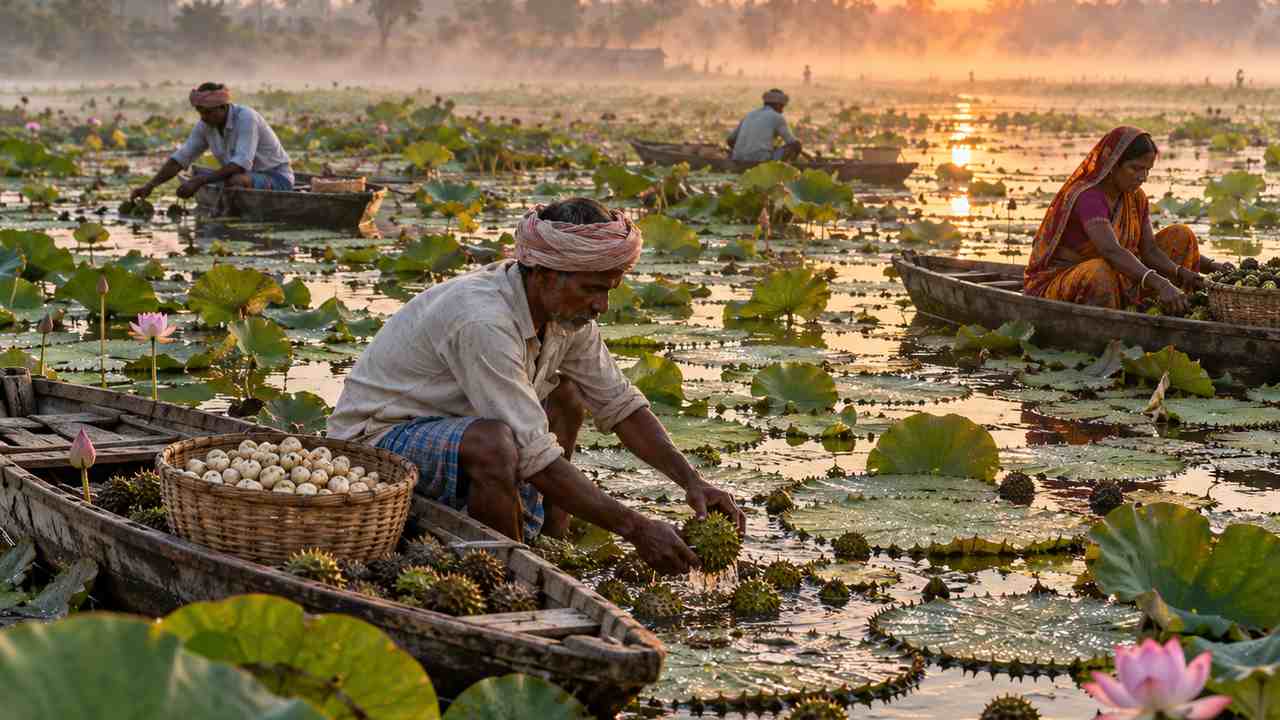
Every makhana kernel starts as a seed at the bottom of a pond in Bihar. Between that pond and the pack on a retail shelf lies one of the most labour-intensive food processes in India: months of cultivation, dangerous deep-water harvesting, and a popping technique that has barely changed in generations. Understanding the process explains why makhana costs what it does, and why quality varies so much between suppliers.
Step 1: Cultivation in Bihar's ponds
Makhana is the seed of Euryale ferox, a water plant grown in the shallow ponds and wetlands of the Mithila region, Purnia, Katihar, Darbhanga and Madhubani. Planting happens around December to January. The plants spread large, spiny leaves across the water surface through spring, flower in summer, and the seeds mature inside spiny pods from August to October.
Most cultivation is still done by small farming families on leased ponds. Yields depend heavily on water levels and weather, which is why a good monsoon, like the one behind the bumper 2026 crop, can swing national prices.
Step 2: Harvesting, the hardest job in the chain
When the pods ripen, they sink and burst, scattering seeds across the pond bed. Harvesters, traditionally from the Mallah community, dive to the pond bottom, gather the seeds by hand in the mud, and wash them at the surface. It is skilled, physically punishing work done in deep, murky water, and it is the main reason makhana cannot be cheaply mechanised at the harvest stage.
Harvested seeds are sun-dried for a few days to bring moisture down before processing.
Step 3: Grading the raw seed
Dried seeds are sorted by size. Larger, denser seeds pop into larger kernels and grade higher later, so this first sorting already decides the value of the lot. Undersized seeds go to lower grades or powder.
Step 4: Roasting and popping
This is the signature step. Workers heat the graded seeds in large iron woks, then strike each hot seed with a wooden hammer-like tool so it pops, the hard black shell splits, and the white kernel bursts out. Timing is everything: roast too little and the seed will not pop; roast too much and the kernel burns. A skilled popper judges readiness by sound and feel, and popping rates directly decide a processor's economics.
Step 5: Polishing and second roasting
Popped kernels are roasted again at lower heat to crisp them fully and drive moisture down to safe levels, then polished in rotating drums to give the familiar creamy-white finish. Properly processed makhana should snap cleanly and taste nutty, never chewy or stale.
Step 6: Grading into sutta sizes
The finished kernels pass through sieves that sort them into the sutta grades, 3 to 7 sutta, and hand sorting removes broken and discoloured pieces. This is where export-grade 6 and 7 sutta lots are separated from retail-grade 4 and 5 sutta. Whole-kernel percentage and moisture are checked lot by lot.
Step 7: Packing and dispatch
Graded makhana is packed in food-grade PP bags, typically 10, 25 or 50 kg for wholesale, with moisture-barrier liners for export. Because makhana absorbs moisture quickly, good packing is not cosmetic: it is what keeps a 6 sutta lot crisp from Bihar to a warehouse in Mumbai or a container to Dubai.
The GI tag: Mithila Makhana
Makhana from the Mithila region of Bihar carries a Geographical Indication tag as Mithila Makhana. For buyers it is a mark of origin authenticity; for sellers it is a trust signal worth putting on packs and wholesale listings. When a supplier claims GI-tagged sourcing, ask which district the lot comes from.
What this means for buyers
- Price follows labour: harvesting and popping are manual, so rock-bottom quotes usually mean compromised grading, not efficiency.
- Ask when the lot was popped. Fresh-season lots (post-October) pop better and stay crisp longer than old stock.
- Moisture is the quality line. Well-dried makhana snaps; damp makhana chews. Reject chewy samples.
- Trace the origin for premium grades. Madhubani and Darbhanga lots command trust for a reason.
Finally, plan purchases around the harvest calendar. Fresh lots arrive from October, prices are usually softest from March to June, and demand peaks around Diwali. Buyers who lock annual supply agreements with processors right after harvest get the best combination of grade consistency and price.
Frequently Asked Questions
How is makhana made?
Makhana seeds are cultivated in Bihar ponds, harvested by divers from the pond bed, sun-dried, graded, then roasted and popped by hand so the kernel bursts from its shell. Kernels are roasted again, polished, graded into sutta sizes and packed.
Where is makhana grown in India?
Almost entirely in Bihar: the Mithila region, Purnia, Katihar, Darbhanga and Madhubani, whose pond ecology suits Euryale ferox cultivation. Mithila Makhana carries a GI tag marking this origin, which buyers treat as an authenticity signal.
Why is makhana expensive?
Harvesting and popping are manual and labour-intensive: divers collect seeds from pond beds by hand, and each seed is popped individually. Yields also depend on the monsoon, so bad seasons push prices up across the chain.
What is the difference between raw and popped makhana?
Raw makhana is the hard black seed; popped makhana is the white, puffed kernel after roasting and popping. Only popped, polished and graded kernels are sold as the makhana you eat or trade.
When is the makhana harvest season?
Seeds mature from August to October, so fresh-crop lots reach the market from October onwards. Fresh-season makhana pops better, grades cleaner and stays crisp longer than old stock, which is why experienced buyers time their annual contracts around harvest.
Related guides
- Makhana Grades Explained: The Sutta Size Chart (3 to 7 Suta)
- How to Start a Makhana Business in India: Investment, Margins & Models
- Makhana Business Profit Margin: Wholesale vs Retail (2026)
Get today's wholesale price
Grades 3–7 sutta · MOQ 25 kg per grade · pan-India dispatch.