Makhana Grades Explained: The Sutta Size Chart (3 to 7 Suta)
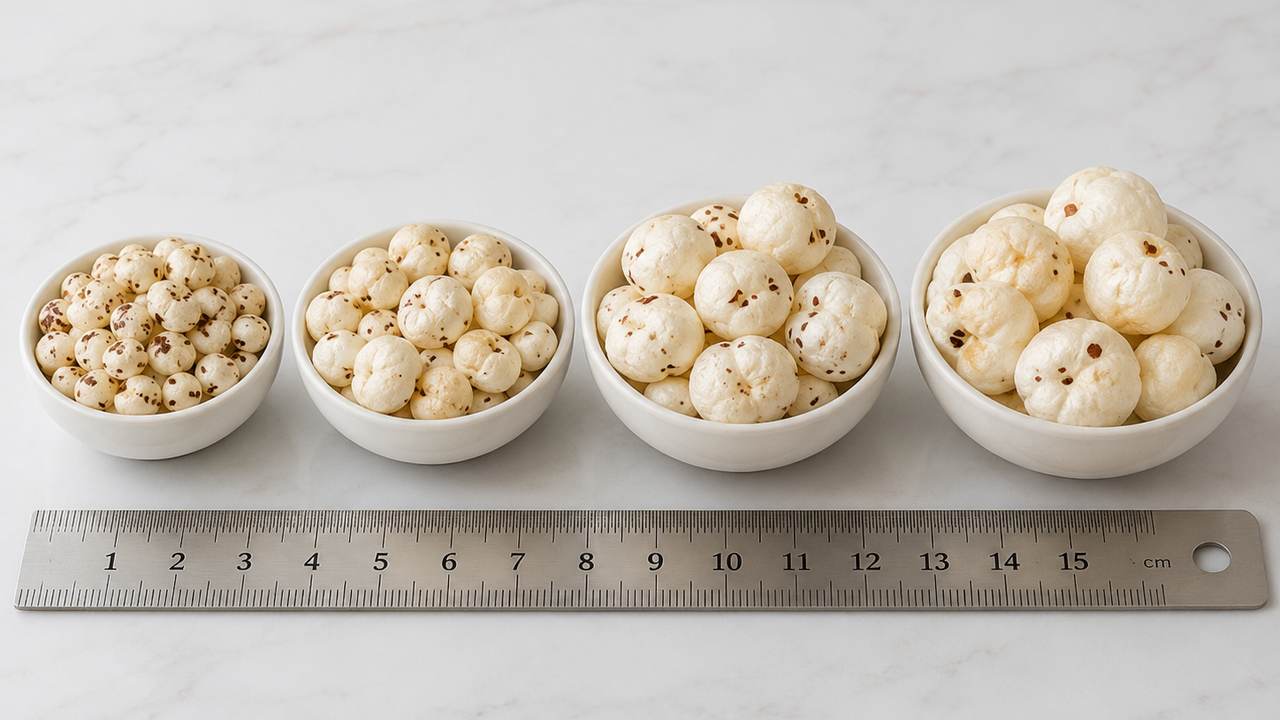
If you are buying makhana in bulk, the single most important word you will hear is sutta (also written suta or soota). It is the industry's grading language: the size of the popped makhana kernel, and it decides the price, the buyer, and the end use. This guide explains the full 3-to-7 sutta scale with mm sizes and indicative October 2026 wholesale prices, so you can order the right grade the first time.
What does sutta mean?
Sutta refers to the diameter of the popped makhana kernel. One sutta is a traditional trade unit, and graders sort kernels by passing them through sieves of fixed mesh size. Bigger, rounder, unbroken kernels grade higher and command higher prices. A 6 sutta kernel is visibly larger than a 4 sutta one, and buyers in retail and export markets pay a premium for that size and uniformity.
The sutta size chart (3 to 7 sutta)
| Grade | Approx. size | Indicative wholesale price (Oct-2026) | Typical use |
|---|---|---|---|
| 3 sutta | ~10 mm and below | Rs. 450 - 600 / kg | Budget packs, powder, murra mixes |
| 4 sutta | ~12 - 14 mm | Rs. 650 - 850 / kg | Retail packing, roasting, flavoured snacks |
| 5 sutta | ~14 - 16 mm | Rs. 850 - 1,050 / kg | Premium retail, gifting, roasting |
| 6 sutta | ~16 - 20 mm | Rs. 1,100 - 1,400 / kg | Export quality, premium retail |
| 7 sutta | ~20 - 26 mm (jumbo) | Rs. 1,400 - 1,800 / kg | Export, luxury gifting |
Prices are indicative October 2026 wholesale bands for Delhi delivery; Bihar mandi rates run lower and metro retail higher. Prices move with the season, so always confirm the day's rate before ordering.
How makhana grading is actually done
Grading happens after popping and polishing, in three passes:
- Mechanical sieving: kernels pass through a stack of sieves with fixed mesh sizes. What stays on each mesh is that sutta grade.
- Hand sorting: workers remove broken pieces (murra), discoloured kernels and undersized pops. The share of whole, round kernels is what separates a true 6 sutta lot from a mixed one.
- Moisture and density check: good lots are dried to safe moisture (around 6 to 8 percent). Damp kernels feel heavy, pop poorly later, and spoil faster.
When a supplier quotes you a grade, ask for the whole-kernel percentage and a sample of 100 grams. A honest 5 sutta lot should show uniform size with minimal breakage. If the sample has mixed sizes, you are being quoted a blended lot at a single-grade price.
Which grade suits your business?
Retail packing and private label: 4 and 5 sutta
These are the volume grades for the Indian retail shelf. 4 sutta gives you the best cost per pack for 100 g and 200 g pouches; 5 sutta lets you position a premium line and gift boxes. Most established retail brands buy 4 sutta for their base range and 5 sutta for their premium range.
Roasting and flavoured snacks: 4 and 5 sutta
Roasters need kernels that are uniform enough to roast evenly. 4 sutta is the workhorse for peri peri, cheese and pudina lines because the raw-material cost keeps the final MRP competitive. 5 sutta suits premium roasted lines.
Export: 6 and 7 sutta
Overseas buyers, especially in the USA, UAE and UK, buy on size and appearance. 6 sutta is the standard export grade; 7 sutta jumbo goes to luxury and gifting channels. Export contracts usually specify maximum breakage (often under 3 percent) and moisture limits, so buy from a grader who can document both.
Budget and value lines: 3 sutta and murra
3 sutta and broken kernels (murra) go into makhana powder, ready-to-cook mixes and economy packs. Margins here are thin, so this grade only works at real volume with tight quality control.
Buying checklist for any grade
- Confirm the spelling and the mm range in writing: suta, sutta and soota all mean the same thing, but the mm size must be stated.
- Ask for whole-kernel percentage, moisture level and a 100 g sample before committing to a bulk lot.
- Check the price against the current mandi band; a quote far below the band usually means mixed grades.
- For 6 and 7 sutta, insist on FSSAI-licensed supply and batch-wise grading if you are exporting.
Get these four points right and the grade system works in your favour: you pay for exactly the size your customers will see, and nothing more.
Frequently Asked Questions
What is sutta in makhana?
Sutta (also spelled suta or soota) is the trade grading unit for popped makhana size. Grades run from 3 sutta (around 10 mm, budget) to 7 sutta (20 to 26 mm, jumbo export grade). Bigger, rounder, unbroken kernels grade higher and cost more per kg.
What is the difference between 5 sutta and 6 sutta makhana?
5 sutta kernels are roughly 14 to 16 mm and suit premium retail and roasting. 6 sutta kernels are 16 to 20 mm, more uniform, and are the standard export grade. In October 2026, 6 sutta wholesales around Rs. 1,100 to 1,400 per kg versus Rs. 850 to 1,050 for 5 sutta.
Which makhana grade is best for a roasting business?
4 sutta is the workhorse grade for roasted and flavoured makhana: uniform enough to roast evenly and cheap enough to keep MRP competitive. Use 5 sutta for a premium roasted line. Always check moisture, since damp kernels roast poorly.
How is makhana graded?
After popping and polishing, kernels pass through sieves of fixed mesh size, then are hand-sorted to remove broken and discoloured pieces. Reputable suppliers state the whole-kernel percentage and moisture level for each lot.
What is the wholesale price of 4 sutta makhana?
Indicative October 2026 wholesale bands put 4 sutta at roughly Rs. 650 to 850 per kg for Delhi delivery. Bihar mandi rates are lower. Prices move with the season, so confirm the day's rate before ordering.
Related guides
- How to Start a Makhana Business in India: Investment, Margins & Models
- Makhana Business Profit Margin: Wholesale vs Retail (2026)
- Makhana Wholesale Price in Bihar 2026: Grade-Wise Mandi Rates
Get today's wholesale price
Grades 3–7 sutta · MOQ 25 kg per grade · pan-India dispatch.